Tune In, Walk On: An Eight-Stop Listening Route Through Kings Heath Park
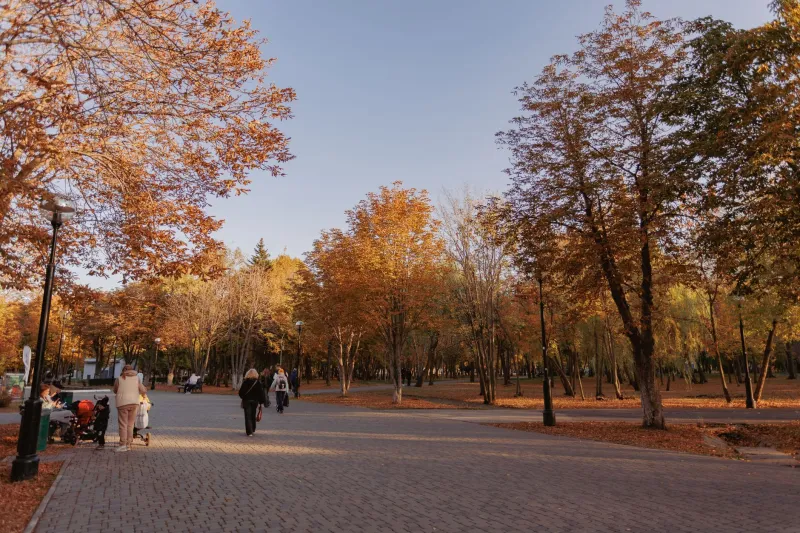
There is a particular kind of November day when the park feels like it's happening to you rather than with you. Leaves underfoot, a nippy edge to the air, the swing creaking somewhere off to your left. You walk the same loop you always walk and, honestly, you could do it with your eyes shut.
So try doing it with your ears open instead. Not in a po-faced, mindfulness-retreat way — more in the spirit of a treasure hunt where the treasure is noise you'd normally filter out. Below is a route you can follow on your own, with a friend, or with a small child who needs convincing that a walk is a game.
Why bother listening, anyway?
Most of us visit a park to look at it. We clock the trees, the flowerbeds, the state of the grass. Sound is the bit we get for free and ignore. But sound is also the thing that changes fastest — minute to minute, season to season, depending on whether it rained last night or whether the football pitches are busy.
A listening walk gives an ordinary visit a bit of structure without turning it into a military operation. You don't need to buy anything, book anything or be any good at it. It's also a quiet way to notice that the park is a shared space, made up of lots of different people having lots of different days. That's worth half an hour of anyone's time in 2026, when most of our attention is being fought over by a screen.
Before you set off
Give yourself five minutes of prep, no more.
- Leave the headphones at home. That's the whole kit list.
- Pick a dry-ish day if you can, though a wet one works too — rain on leaves is one of the park's best sounds.
- Go at a wander, not a march. The route below is roughly 40 to 50 minutes at a pottering pace.
- Agree a rule with children: everyone gets one turn to say "shh, listen" and everyone else has to stop and do it. Power-sharing works wonders.
The route: eight stops, no rush
You can do these in any order, but this sequence works nicely as a loop from the main entrance.
1. The gate and the first fifty metres
Stand still just inside the entrance for a full minute. Don't walk and listen — just listen. You'll hear the road behind you, then, gradually, the park in front of you. Prompt: which sound arrives last?
2. The playground edge
You don't have to go in. Stand near enough to hear it. Swings have a rhythm, and so do the shouts. Prompt for children: can you hear three different kinds of happy noise? Prompt for adults: how far away can you still hear the swings before they disappear?
3. The gravel path
Gravel is the park's most underrated instrument. Walk it slowly, then quickly, then slowly again. Prompt: does it sound different when someone else walks it towards you?
4. Under the biggest tree you can find
Stop beneath the canopy and look up, then close your eyes for thirty seconds. Even in November there's life up there — woodpigeons, crows, the odd chattering sparrow. Prompt: birdsong or bird chatter? There's a difference, and once you've spotted it you can't un-spot it.
5. The bench with the best view
Sit down. This stop is entirely about the hush between conversations. Listen to the gaps rather than the words. Prompt: what's the quietest thing you can hear from here?
6. The open grass
Out in the open, sound behaves differently — it travels further and flattens out. Prompt: can you hear the road from here? Can you hear the playground? Which one wins?
7. The boundary path
Walk along the edge of the park for a minute or two. This is where the park and the city meet. Distant traffic, a bin lorry, a door slamming, a bus sighing to a stop. Prompt: which of those sounds would you draw if you had to make a picture of this exact spot?
8. Back where you started
Return to the gate and listen again for a minute. It'll sound different now. Not because the park has changed, but because you have.
Prompts to borrow
If you want a few more things to listen for, pinch these:
- The counting game: how many separate sounds can you hear in sixty seconds? Children are brutally competitive at this, which is the point.
- Near and far: point at the closest sound, then the furthest. Swap.
- The mimic: try to copy one sound — a pigeon, a swing, a gate. Bonus points for whoever gets closest.
- The weather check: does the park sound different when it's damp? (Spoiler: yes. Everything is muffled and closer.)
- The one-minute silence: no talking, no phones, just listening. It is harder than it sounds and better than it sounds.
A note for the noisy days
Here's the gentle argument for all of this. We tend to think of parks as places to look at, or places to burn off energy, or places to tick off a walk. Listening adds a third thing: the park as somewhere that is always happening, whether or not you're paying attention.
That's a small idea, but it's a useful one on a day when your head is full. You don't have to meditate, you don't have to leave your phone in a box, and you certainly don't have to be quiet the whole time. You just have to notice that the park has a soundtrack — and that you're in it.
Come back in spring and do the same route again. It'll be a completely different walk. That's the trick of it: the map stays the same, the sounds never do.