Six Benches, No Rush: A Slow Loop Through Kings Heath Park
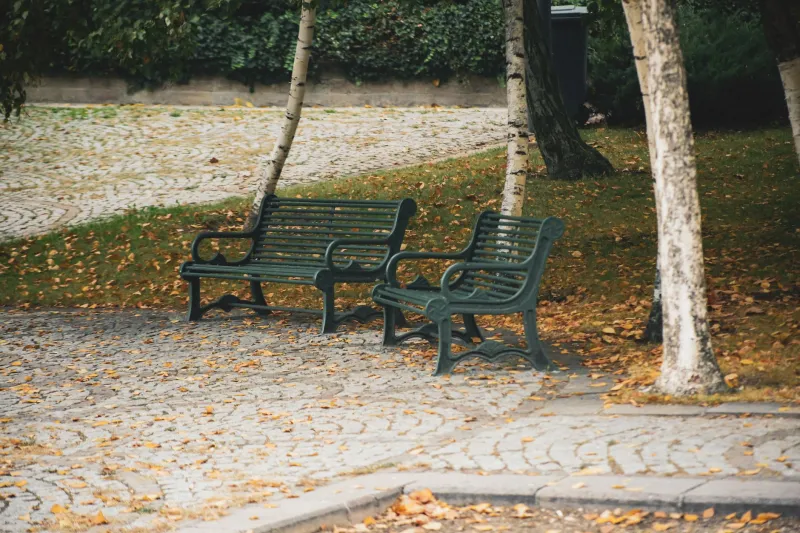
We are a country of striders. Step counters, parkruns, brisk walks with a podcast at 1.5 speed. None of that is bad. But there is another way to use a park, and it involves sitting down more than you might expect.
This is an opinion, offered gently: a slow loop between the benches of Kings Heath Park can be just as rewarding as a big day out. Not instead of a proper walk, but alongside it. A way of paying attention to a place you think you already know.
The route is simple. Start at the main Alcester Road gate, follow the main paths, and let six benches be your waypoints. No target pace. No need to finish. If you do the whole thing, give it an hour. If you do three benches and go home, that counts.
Bench one: the gate bench
The first bench is where the park meets the street. It is a threshold, and thresholds are interesting. Watch the dog walkers, the school groups, the people carrying folding chairs to a match, the cyclist who always cuts it fine at the gate.
Kings Heath Park has been a public green space since the late Victorian period, laid out for a growing suburb that needed somewhere to breathe. The gate bench is a good place to remember that parks were not designed as scenery. They were designed as social infrastructure. A place to meet, to promenade, to see and be seen.
Etiquette note: do not block the gate. Share the bench. A nod is enough. If someone is waiting, shuffle up.
Bench two: the playground bench
This is the hardest bench to sit on properly. It is a parent’s office, a grandparent’s observation post, a place of lost hats and last-minute negotiations. The etiquette here is specific: watch your own children, not other people’s. Do not photograph strangers. Do not offer unsolicited advice about coats.
In November the after-school rush hits around 3.30pm, and the bench becomes a small theatre of tiredness. The children run. The grown-ups scroll. Then someone opens a packet of biscuits and the whole ecosystem shifts. Sit for two minutes, not twenty. Notice how quickly the mood changes when the first child is told it is time to go.
Bench three: under the lime trees
There is a bench under the lime trees — you will know it by the soft, damp smell of bark and the way the sound changes when you sit down. The traffic on Alcester Road becomes a hum rather than a roar. Robins get bold. Squirrels make their business look urgent.
November is a good month for looking down as well as up. Wet leaves plaster themselves to the path in patterns. Bare branches show the shape of the trees. The park is stripping back to its structure, and that is worth a few minutes of your time.
If you are walking with someone, this is the bench for the conversation that does not need eye contact. If you are alone, this is the bench for doing nothing. Doing nothing is a skill. Practise.
Bench four: the water’s edge
The pond bench asks you to look at reflections. In late autumn the water holds the sky longer than the path holds the light, and the ducks and moorhens go about their business with the calm of creatures who have never had a deadline.
Please do not feed bread to the birds. Oats or proper wild bird seed if you must, but honestly, they are fine. The bigger pleasure is watching the water settle after a dog has crashed through the margins, or the way a single leaf can hold the whole attention of a small child.
This is also the bench where people-watching etiquette matters most. Give space. Do not hover behind someone who is clearly having a quiet moment. A park bench is a shared resource, not a stage.
Bench five: the bowling green bench
Bowling greens are a reminder that parks have always been about organised fun as well as fresh air. The flat green, the trimmed edges, the little俱乐部 hut feeling — it is a slice of social history that survives mostly because people kept showing up.
In November the green is quiet. The bench is for watching weather rather than sport. Notice how the light moves across the flat surface. Notice the people who walk past it every day without ever looking. This bench is a good place to feel mildly smug about slowing down.
Bench six: the top bench
Every park has a high point, even a gentle one. The top bench gives you the long view: rooftops, tree crowns, the pale wash of a November sky. It is the end of the loop, and the right place to decide that you have done enough.
A slow loop is not a fitness regime. It is a relationship with a place. You start to notice the same dogs, the same faces, the same small changes. The bench that was sunny in September is in shade by November. The path that was dry last week has a puddle in the same spot. The park is not a backdrop. It is a neighbour.
Why slow works
Mindfulness without the jargon, if you like. The point is not to empty your mind. The point is to fill it with something local and low-stakes for an hour. A big day out gives you a story to tell. A slow loop gives you a place to return to.
It is also accessible. The main paths are level enough for most wheels, and the benches give you permission to stop. You do not need special kit. You do not need to be fit. You do not need to spend anything. You just need to be willing to go a bit slower than usual.
Practical notes
Weekday mid-mornings are quiet. Late afternoon is lively but crowded with school traffic. Bring a flask. Wear layers. Stick to the main paths after wet weather unless you enjoy mud. Dogs should be on leads near the playground, and litter goes home with you. If you want a shorter version, do benches one to three and double back.
Go slowly. The park is not going anywhere. That is the point.