Nine Squirrels and a Notebook: Turning a Kings Heath Park Stroll Into a Family Wildlife Survey
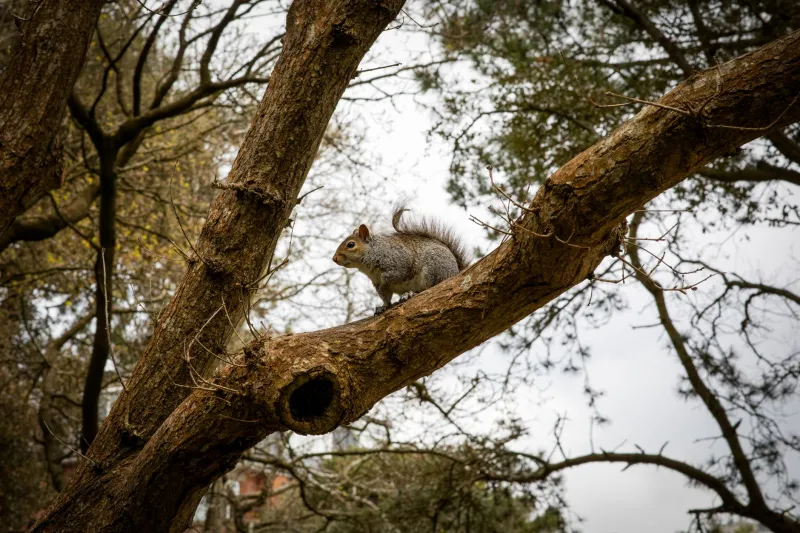
Most walks through the park follow the same shape. In through the gate, across the grass, a hopeful detour to the play area, home again. Lovely, but slightly samey. So here's a small twist that costs nothing and changes everything: give the walk a job. Not a big, worthy job. A tally. For forty-five minutes, your family becomes a very amateur, very cheerful wildlife survey team, counting squirrels.
It sounds almost too simple to bother with. It isn't. Give a child a clipboard and a genuine reason to look up into the branches, and the same old path turns into a place full of movement, noise and possibility. Grown-ups get it too — there's something quietly restorative about spending three-quarters of an hour with your only task being notice things.
Why count squirrels at all?
Grey squirrels are the park's most reliable wildlife encounter. They're here all year, they're active in daylight, and they're gloriously unbothered by people. That makes them an ideal first species for anyone learning to watch rather than simply look.
Counting them is also genuinely useful. Casual records from ordinary park users — sometimes called citizen science, sometimes just "someone wrote it down" — help build a picture of how wildlife is faring in urban green spaces. Without that picture, squirrels are either everywhere or nowhere, depending on who you ask. With it, you can start to say something real: numbers here, in this corner, at this time of year.
What you actually need
Less than you'd think. A pencil each. Something to lean on — a hardback book works, so does a cereal box. One sheet of paper with four columns: time, place, how many, what they were doing. Add a flask if the weather's cold, and a snack if the small members of the team are likely to strike.
One thing to leave at home: bags of monkey nuts. More on that in a moment.
Picking a loop that isn't a route march
Keep it short. A squirrel count wants slow movement, not distance. A gentle circuit of roughly fifteen to twenty minutes' walking, walked twice at a snail's pace, will out-perform a two-mile yomp every time.
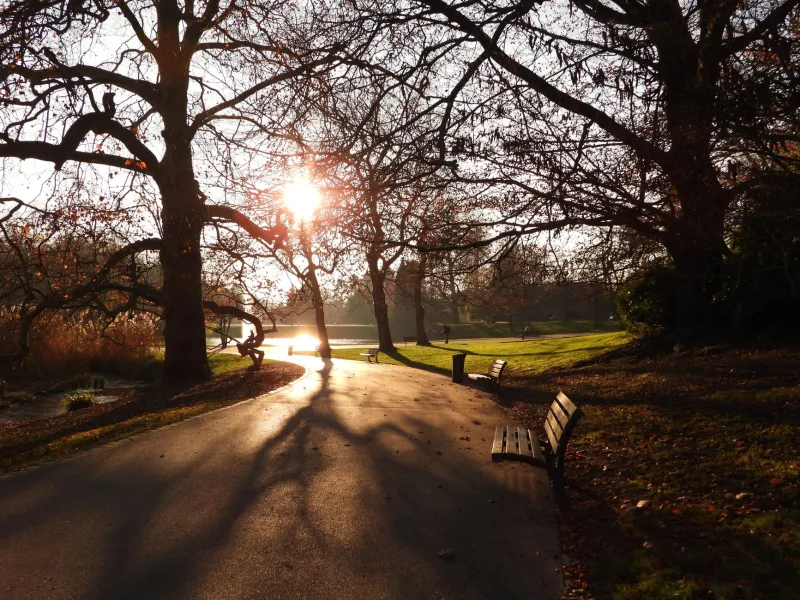
Start somewhere with mature trees and a bit of open ground beside them — the edge habitat where branches meet grass is where you'll see most activity. Follow the tree line rather than cutting across the middle. Include one bench stop, ideally with a view down a path, because squirrels use paths as corridors and a stationary watcher sees far more than a moving one.
If you've got very small legs in the party, don't fret about a full loop. One good stretch of trees, walked slowly in both directions, is plenty.
How to spot without scaring them off
Squirrels give themselves away in four ways, and once you know them you can't un-know them.
- The rustle. Leaf litter is a giveaway. Stop, stand still, listen.
- The tail flick. Squirrels often sit tight on a branch and betray themselves with a twitch. Scan trunks and forks at about head height and above.
- The dash. That low, looping sprint across the grass, usually ending at a tree base.
- The half-eaten evidence. Nibbled cones, stripped bark, buried-and-forgotten caches.
Teach the team the two-metre rule: watch from a distance, don't approach, don't try to get the squirrel to come closer. A squirrel that's been fed will approach people, and that's a squirrel that's lost its wariness — which isn't a kindness to it.
The tally itself
Keep it simple enough that a six-year-old can run it and an adult can still enjoy the walk.
- Log the sighting the moment it happens. Memories compress: after twenty minutes, three sightings become "loads".
- Count individuals, not sightings. If a squirrel runs behind a tree and reappears, that's one squirrel, not two. It's genuinely difficult. Nobody will mind a small margin of error.
- Note the behaviour in a word or two: digging, chasing, eating, sitting, climbing, running.
- Mark the spot loosely. "By the big tree near the bench" is a perfectly good location note.
Then, at the end, add up the total and write the date on top. That's it. You've made a record.
The one rule that really matters
Do not feed them. Not a handful of nuts, not a stray bit of sandwich, not "just to get a photo". Fed squirrels become bold, bold squirrels get close to buggies, dogs and roads, and the whole thing ends badly for the squirrel. Feeding also concentrates animals in unnatural numbers and spreads disease more easily.
You can watch brilliantly without a single peanut changing hands. Standing still for two minutes beats waving a snack for twenty.
When to go
Timing is more than half the job.
- Early morning, within an hour or so of opening-up time, is the best window. Squirrels are foraging hard after the night.
- Mid-morning to early afternoon is the reliable second-best.
- Late autumn and winter are excellent because the leaves are down and the branches are bare — every tail is visible.
- Avoid wind and heavy rain. Squirrels go quiet, and so will your team.
- Half-term and school holidays are busier, which is fine for people-watching but slightly harder for wildlife-watching. Go earlier.
What to do with the numbers
Nothing dramatic. Write the total and the date in the back of the notebook and come back in a fortnight. Do it again. Do it in spring. Very quickly you'll have something no website can give you: a small, personal dataset about one patch of Birmingham.
If the team catches the bug, records can be passed to local wildlife recording schemes and to the park's volunteer groups, who are always glad of a clearer picture of what's living where. Children who've contributed a real record to a real thing tend to remember it for a long time.
Why this matters in 2026
Urban green space is doing more work than ever. It's shade in hotter summers, drainage in wetter winters, and a corridor for wildlife across a city that would otherwise be a maze of tarmac and fences. Trees are the infrastructure; squirrels are the visible proof it's functioning.
That's the quiet point of the whole exercise. A tally sheet turns the park from scenery into habitat — something that can be measured, and therefore something worth sticking up for. It also gives a family a reason to spend forty-five minutes outside together doing almost nothing, which in 2026 might be the rarest thing on the list.
So go on. Nine squirrels, or nineteen, or a slightly disappointing two. Pencil, paper, a slow loop round the trees. The count starts at the gate.